SNAP FRAUD INVESTIGATION LEADS TO INDICTMENT IN CLAIBORNE COUNTY
JACKSON, MISS — The Mississippi Department of Human Services (MDHS), Office of Inspector General, Division of Investigation, announced a Marshall County resident has been indicted following an investigation involving the fraudulent receipt of Supplemental Nutrition Assistance Program (SNAP) benefits.
Adrianna Allen of Claiborne County was arrested on June 24, 2026, after an investigation determined she improperly received $28,330.00 in SNAP benefits. The case was referred to the Claiborne County District Attorney’s Office where an indictment was secured on June 9, 2026. Allen was subsequently taken into custody by Claiborne County authorities.
“This is a great example of collaboration between our investigations team, MDHS county offices, District Attorneys, and local law enforcement,” said Sandra Griffith, MDHS Inspector General.
The investigation was conducted by Agent Griffin with the MDHS Office of Inspector General’s Division of Investigation. Established in 2018, the Division of Investigation is responsible for detecting, preventing and deterring fraud, waste and abuse and has recovered millions in SNAP overpayments since its inception.
“This investigation and indictment demonstrate the effectiveness of the safeguards that we have put in place to detect, investigate and prevent fraud,” said Robert G. “Bob” Anderson, MDHS Executive Director. “Every step we take to prevent fraud ensures that resources and support will continue to reach the Mississippians who need it most.”
An indictment is only an allegation. All defendants are presumed innocent until proven guilty beyond a reasonable doubt in a court of law.
Suspected fraud can be reported to MDHS at any time by submitting the Fraud Tip Form online at https://www.mdhs.ms.gov/report-fraud/, calling the Fraud Tip Line at 1‑800‑299‑6905, or emailing fraud@mdhs.ms.gov.
###
SNAP FRAUD INVESTIGATION LEADS TO INDICTMENT IN CLAIBORNE COUNTY
JACKSON, MISS — The Mississippi Department of Human Services (MDHS), Office of Inspector General, Division of Investigation, announced a Claiborne County resident has been indicted following an investigation involving the fraudulent receipt of Supplemental Nutrition Assistance Program (SNAP) benefits.
Kia Mays of Claiborne County was arrested on June 24, 2026, after an investigation determined she improperly received $25,124.00 in SNAP benefits. The case was referred to the Claiborne County District Attorney’s office where an indictment was secured on June 9, 2026. Mays was subsequently taken into custody by Claiborne County authorities.
“This is a great example of collaboration between our investigations team, MDHS county offices, District Attorneys, and local law enforcement,” said Sandra Griffith, MDHS Inspector General.
The investigation was conducted by Agent Griffin with the MDHS Office of Inspector General’s Division of Investigation. Established in 2018, the Division of Investigation is responsible for detecting, preventing and deterring fraud, waste and abuse and has recovered millions in SNAP overpayments since its inception.
“This investigation and indictment demonstrate the effectiveness of the safeguards that we have put in place to detect, investigate and prevent fraud,” said Robert G. “Bob” Anderson, MDHS Executive Director. “Every step we take to prevent fraud ensures that resources and support will continue to reach the Mississippians who need it most.”
An indictment is only an allegation. All defendants are presumed innocent until proven guilty beyond a reasonable doubt in a court of law.
Suspected fraud can be reported to MDHS at any time by submitting the Fraud Tip Form online at https://www.mdhs.ms.gov/report-fraud/, calling the Fraud Tip Line at 1‑800‑299‑6905, or emailing fraud@mdhs.ms.gov.
###
MDHS LAUNCHES NEW CONNECTEBT APP AND CARD LOCK FEATURE
A Step Forward in EBT Fraud Prevention Measures in Mississippi
JACKSON, MISS – The Mississippi Department of Human Services (MDHS) announces a new mobile app and enhanced security features for recipients of the Supplemental Nutrition Assistance Program (SNAP) launching June 11, 2026. The ConnectEBT app introduces a card lock feature designed to help protect benefits from theft and unauthorized use.
As part of the update, all Mississippi EBT cards will automaticallybe set to block online and out-of-state SNAP transactions beginning June 11. This default security setting is designed to reduce the risk of fraud while still allowing SNAP clients to make purchases at authorized Mississippi retailers.
The ConnectEBT app is available for free on Android or Apple devices, allowing clients to manage their benefits directly from their phones. Clients can register a new account or log in using their ConnectEBT client website username and password.
Clients will have access to three security settings:
Lock My Card Everywhere Provides the highest level of protection by blocking all EBT transactions until the client chooses to unlock the card.
Block-High Risk Transactions (Default Setting) Blocks all online and out-of-state SNAP transactions while still allowing purchases at authorized Mississippi retailers.
Unlock My Card Everywhere Allows transactions wherever EBT cards are accepted, including online and out-of-state purchases.
These features are also available through the existing ConnectEBT website.
Mississippi is among a limited number of states offering the ConnectEBT app and the advanced card-locking functionality. Reflecting Mississippi’s continued efforts to strengthen benefit security and reduce fraud.
In addition to the card security features, ConnectEBT app users can also:
Change their EBT PIN
Lock and unlock their EBT cards between purchases
Monitor their account activity
Clients who need to make online purchases or use their SNAP benefits while traveling can adjust their security settings through:
MDHS encourages clients to regularly monitor their accounts, lock their card manually or use the auto-lock feature following every purchase and change their EBT PIN at least monthly.
MDHS wants to make it easier to stay connected with you.
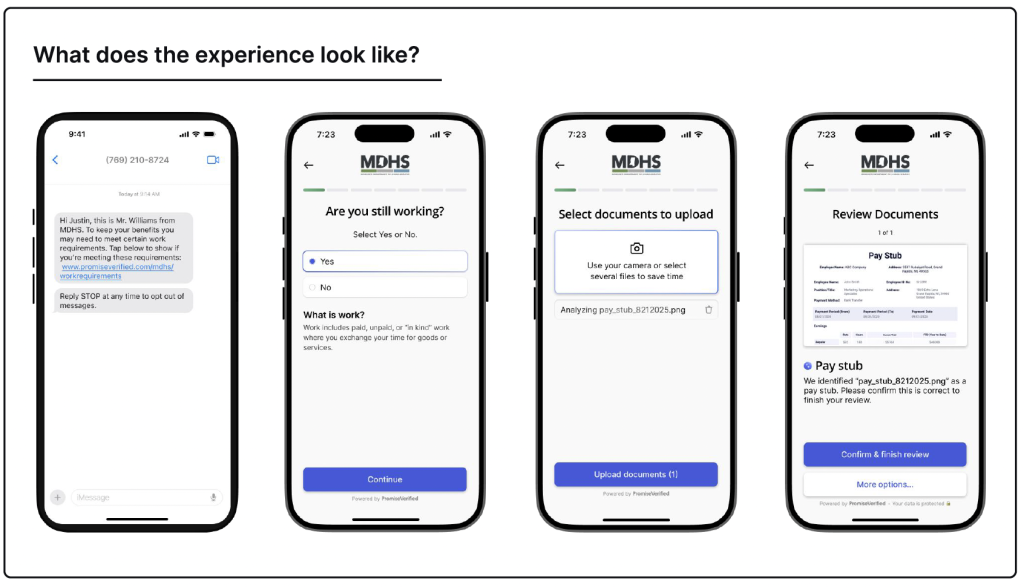
The Mississippi Department of Human Services (MDHS) is partnering with Promise to help SNAP recipients stay up to date and in compliance. You may receive text message reminders for work reporting, recertification deadlines, and documents you need to provide to ensure timely processing.
Through these messages, you will be guided to upload documents, which will be securely sent directly to their MDHS caseworker. Following a successful pilot in Harrison County and Pearl River County, these messages are now statewide.
You may receive text messages from 769-210-8724 or emails from no-reply@promise-gov.com that reference MDHS, Promise, and their assigned caseworker. If you have questions, you can call or text 1-800-948-3050 for assistance.
MDHS Announces Issuance of Remaining November SNAP Benefits
JACKSON, MS – Following official guidance from the United States Department of Agriculture’s (USDA) Food and Nutrition Service (FNS), the Mississippi Department of Human Services (MDHS) will issue full November SNAP benefits as soon as possible.
MDHS will begin issuance as soon as possible to clients with issuance dates of November 4th through 13th. This follows the announcement of partial benefit issuance on Monday.
Clients with issuance dates between November 14th and 21st will receive up to 65% of their November SNAP benefit amount based on household size and circumstance on their regularly scheduled issuance date. Remaining November benefits will be issued separately and as soon as possible. We appreciate your patience as we work to ensure 100% of November SNAP benefits are issued.
SNAP recipients are advised to:
Register for a Connect EBT account and save ConnectEBT to their cell phone home screen to change their PIN after every use to reduce their risk of being the victim of fraud and skimming. (See TUTORIAL)
Monitor all account transactions and report any suspicious activity to MDHS. https://www.mdhs.ms.gov/help/snap/snap-fraud/
Ensure all case information is current to avoid interruptions in benefits.
Follow MDHS social media channels for the latest updates on additional benefit funding and program announcements.
For the latest details, visit www.mdhs.ms.gov or follow official MDHS social channels.
###
Life Beyond Abuse: The Jenny Head Story
A Journey from Victim to Survivor
Jackson, MS – By all accounts, Jenny Head’s life was the picture of the American dream. Two children, husband, and small business owner, Jenny had planted firm roots on the Mississippi Gulf Coast. But what we see on the outside, may not always be the reality of what many women and children are experiencing behind closed doors.
Jenny is a tragic example of the hidden nature of domestic violence. Following many years of abuse at the hands of her husband, Jenny’s world was turned upside down. She found out that her husband was not only abusing her but at the same time he was systematically tearing down her successful cleaning business. Having had enough, Jenny garnered the strength to seek out help from the Domestic Violence Center for Women on the Mississippi Gulf Coast.
During this time she found herself at the MDHS office in Harrison County where she came looking for help. “I came from working for myself to being forced to seek assistance from both community based and government assistance programs.” she recalls.
Jenny thinks back to her uncertainty as she entered the MDHS office, stating I walked to the window and said, ‘I don’t know. This is where I’m at, and this is what I’m doing. The lady behind the glass reassured me, ‘It’s going to be okay. We can help you get SNAP so you have food for your kids.’
Through the dedication of her Case Manager, Jenny was not only connected to SNAP but also to Medicaid, a job with a Coast municipality, childcare assistance, and other wraparound services that would empower her during her transition out of her abusive marriage.
With the support of the Domestic Violence Center for Women, along with vital assistance from MDHS, she secured a divorce and a protection order that remains in effect to this day.
With determination, she fought to provide not only security and daily necessities, but to help her children thrive and experience hope. For several years, Jenny continued working in the community, with an ever-growing yearning in her heart to help women and families similarly affected by domestic violence.
Jenny shared her desire to make a difference with a friend who encouraged her to apply for an open clerical position at her local MDHS county office.
Jenny accepted the position as a clerical worker and six months later was promoted to caseworker therefore giving her the opportunity to help women experiencing similar challenges to the ones she had faced.
Jenny now uses her lived experience to dedicate her life to helping families facing similar struggles. “I understand how hard it is to ask for help. My story has empowered me to assist others in need.”
Recently, she helped a woman in a similar situation as her own, connecting her with essential resources for safety and support. She told Jenny that she helped save her and her kids’ lives.
Her commitment to helping others is deeply rooted in her own experiences. “I just know the stages that you can go through,” she says, noting how her understanding resonates with clients. “When I talk to them about their struggles, they realize I truly know what they’re going through.”
Through her journey and experiences helping others, Jenny reflects on the other life lessons she has learned along the way. Recounting the 20 years she spent living in fear as a victim of domestic violence. “I felt like no one cared, and no one would help.”
As a Survivor, “I learned to love again,” she reflects, celebrating her loving marriage of 14 years and the nurturing environment she has built for her children. “Mine is a Cinderella story,”
Jenny emphasized the importance of recognizing that domestic violence affects everyone. “It’s not just women; men experience it too. They need to know that there’s help out there—shelters and resources are available for all.” Her mission is clear: “I’m here for the whole run. I’m not going anywhere. I want to help who I can help.”
As we observe Domestic Violence Awareness Month, MDHS urges the community to remain vigilant and compassionate towards those who suffer in silence. “We must look for signs when someone needs help,” she implores.
MDHS offers a range of support services to help individuals and families affected by domestic violence, including:
Financial Assistance: Programs such as SNAP (Supplemental Nutrition Assistance Program) and TANF (Temporary Assistance for Needy Families) to support families in need.
Workforce Development:Job training and employment services to help individuals gain skills and find stable employment.
Food Assistance Programs:Nutritional support through various food programs to ensure families have access to healthy meals.
Child Care Assistance:Help with finding affordable childcare options for working families.
If you are looking for assistance with any of the programs MDHS offers, please visit mdhs.ms.gov and find your local county office.
“Hopefully, my story can help somebody realize that there is always a second chance,” Mrs. Head concludes. “Just remember, the first time is not always the last time.”
If you or someone you know is experiencing domestic violence or the threat of domestic violence, call the National Domestic Violence Hotline for help at 1-800-799-SAFE (7233), or go to www.thehotline.org for anonymous, confidential online chats, available in English and Spanish.